
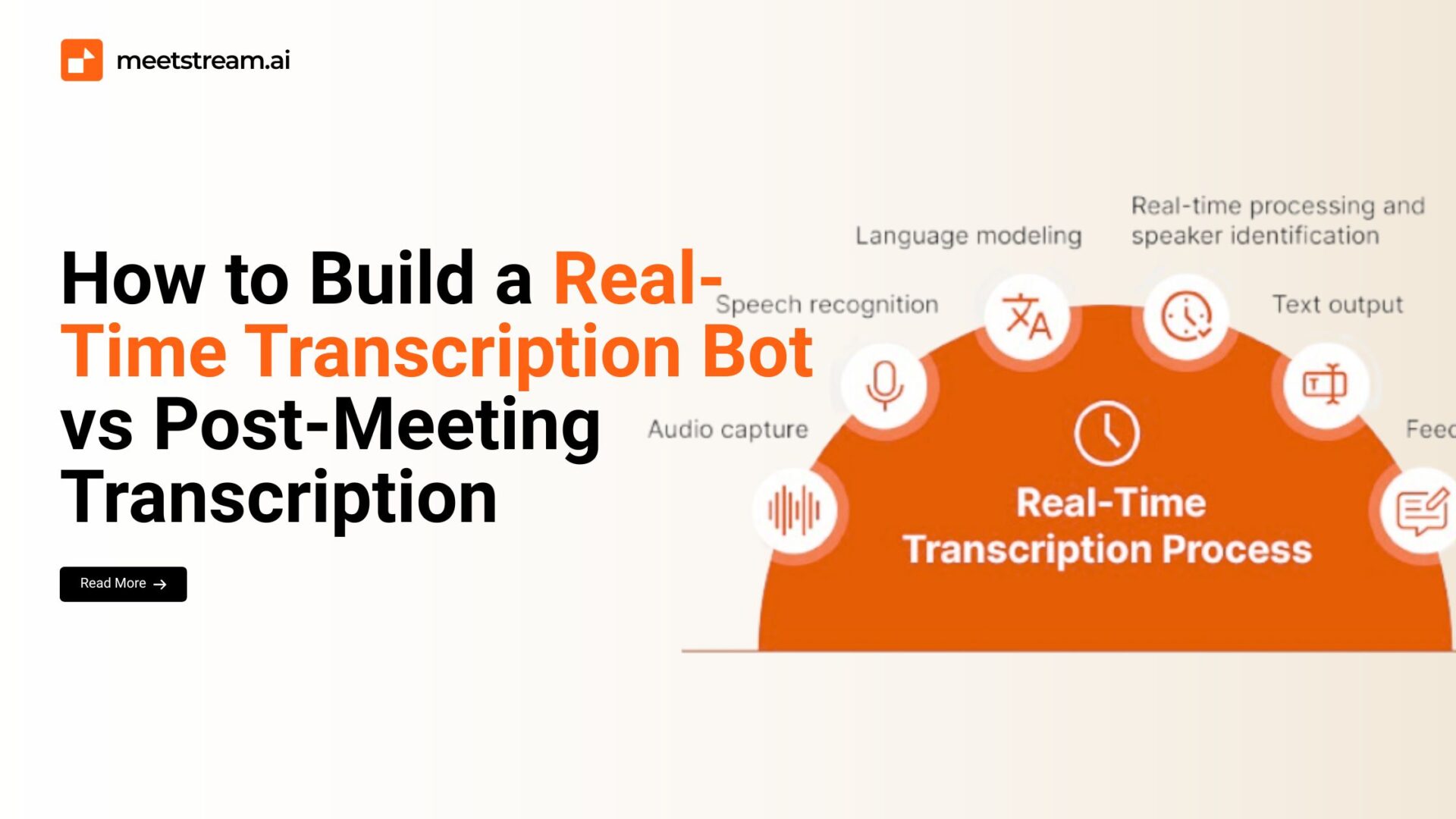

Choosing between real-time and post-meeting transcription fundamentally shapes your architecture.
Real-time systems stream audio chunks for instant captions, requiring low-latency pipelines and websocket connections.
Post-meeting systems process complete recordings, allowing batch optimization and higher accuracy.
This guide demonstrates both approaches, helping you choose the right architecture for your use case.
Understanding the Trade-offs
Real-time transcription delivers instant feedback but sacrifices accuracy for speed.
Post-meeting processing achieves higher accuracy through context analysis and multiple passes but delays results.
Real-time systems cost more—streaming APIs charge per second. Post-meeting systems batch process efficiently but can’t provide live captions.
Real-Time Transcription Architecture
Build a streaming transcription bot using websockets:
import asyncio
import websockets
import json
import base64
from deepgram import Deepgram
class RealtimeTranscriptionBot:
def __init__(self, api_key):
self.dg_client = Deepgram(api_key)
self.socket = None
self.transcript_buffer = []
async def start_stream(self, audio_stream):
“””Start real-time transcription stream”””
# Configure streaming options
options = {
‘punctuate’: True,
‘interim_results’: True,
‘language’: ‘en-US’,
‘model’: ‘nova-2’,
‘smart_format’: True,
‘diarize’: True,
‘encoding’: ‘linear16’,
‘sample_rate’: 16000
}
# Create streaming connection
self.socket = await self.dg_client.transcription.live(options)
# Register event handlers
self.socket.registerHandler(
self.socket.event.TRANSCRIPT_RECEIVED,
self._on_transcript
)
self.socket.registerHandler(
self.socket.event.CLOSE,
self._on_close
)
# Start audio streaming
await self._stream_audio(audio_stream)
async def _stream_audio(self, audio_stream):
“””Stream audio chunks to transcription service”””
try:
while True:
# Get audio chunk (typically 100-200ms)
chunk = await audio_stream.read(3200) # 200ms at 16kHz
if not chunk:
break
# Send to transcription service
self.socket.send(chunk)
# Small delay to prevent overwhelming the API
await asyncio.sleep(0.01)
except Exception as e:
print(f”Streaming error: {e}”)
finally:
# Signal end of stream
self.socket.finish()
def _on_transcript(self, result):
“””Handle incoming transcript results”””
transcript_data = json.loads(result)
# Check if this is a final result
is_final = transcript_data.get(‘is_final’, False)
channel = transcript_data.get(‘channel’, {})
alternatives = channel.get(‘alternatives’, [])
if alternatives:
transcript = alternatives[0].get(‘transcript’, ”)
confidence = alternatives[0].get(‘confidence’, 0)
if is_final and transcript.strip():
# Final result – save to buffer
words = alternatives[0].get(‘words’, [])
speaker = words[0].get(‘speaker’, 0) if words else 0
entry = {
‘speaker’: speaker,
‘text’: transcript,
‘confidence’: confidence,
‘timestamp’: words[0].get(‘start’, 0) if words else 0,
‘is_final’: True
}
self.transcript_buffer.append(entry)
print(f”[FINAL] Speaker {speaker}: {transcript}”)
elif transcript.strip():
# Interim result – display but don’t save
print(f”[INTERIM] {transcript}”, end=’\r’)
def _on_close(self, _):
“””Handle connection close”””
print(“\nTranscription stream closed”)
def get_transcript(self):
“””Get accumulated transcript”””
return self.transcript_buffer
def save_transcript(self, filename):
“””Save real-time transcript to file”””
with open(filename, ‘w’, encoding=’utf-8′) as f:
f.write(“Real-Time Transcript\n”)
f.write(“=” * 60 + “\n\n”)
for entry in self.transcript_buffer:
timestamp = self._format_time(entry[‘timestamp’])
speaker = f”Speaker {entry[‘speaker’]}”
text = entry[‘text’]
confidence = entry[‘confidence’]
f.write(f”[{timestamp}] {speaker} (conf: {confidence:.2f}):\n”)
f.write(f”{text}\n\n”)
def _format_time(self, seconds):
“””Format seconds to MM:SS”””
minutes = int(seconds // 60)
secs = int(seconds % 60)
return f”{minutes:02d}:{secs:02d}”
Post-Meeting Transcription Architecture
Build a batch processing system for recorded audio:
import assemblyai as aai
import os
class PostMeetingTranscriber:
def __init__(self, api_key):
aai.settings.api_key = api_key
def transcribe_recording(self, audio_file):
“””Transcribe complete recording with maximum accuracy”””
# Configure for maximum accuracy
config = aai.TranscriptionConfig(
speaker_labels=True,
speakers_expected=None, # Auto-detect
punctuate=True,
format_text=True,
diarize=True,
# Enhanced features for post-processing
auto_highlights=True,
content_safety=True,
iab_categories=True,
sentiment_analysis=True,
entity_detection=True,
# Language settings
language_code=”en_us”,
language_detection=True,
# Accuracy boosting
boost_param=”high”
)
print(“Starting transcription (this may take several minutes)…”)
transcriber = aai.Transcriber()
transcript = transcriber.transcribe(audio_file, config=config)
if transcript.status == aai.TranscriptStatus.error:
raise Exception(f”Transcription failed: {transcript.error}”)
print(“Transcription complete!”)
return transcript
def generate_comprehensive_output(self, transcript):
“””Generate detailed output with all insights”””
output = {
‘transcript’: self._format_transcript(transcript),
‘summary’: self._extract_summary(transcript),
‘highlights’: self._extract_highlights(transcript),
‘action_items’: self._extract_action_items(transcript),
‘sentiment’: self._analyze_sentiment(transcript),
‘topics’: self._extract_topics(transcript),
‘speakers’: self._analyze_speakers(transcript)
}
return output
def _format_transcript(self, transcript):
“””Format transcript with speaker labels”””
formatted = []
for utterance in transcript.utterances:
timestamp = self._format_time(utterance.start / 1000)
speaker = f”Speaker {utterance.speaker}”
text = utterance.text
formatted.append({
‘timestamp’: timestamp,
‘speaker’: speaker,
‘text’: text
})
return formatted
def _extract_summary(self, transcript):
“””Extract meeting summary”””
if hasattr(transcript, ‘summary’) and transcript.summary:
return transcript.summary
# Fallback: Create basic summary from highlights
if hasattr(transcript, ‘auto_highlights’):
highlights = transcript.auto_highlights
if highlights and highlights.results:
summary_points = [h.text for h in highlights.results[:5]]
return ‘ ‘.join(summary_points)
return “No summary available”
def _extract_highlights(self, transcript):
“””Extract key highlights”””
highlights = []
if hasattr(transcript, ‘auto_highlights’) and transcript.auto_highlights:
for highlight in transcript.auto_highlights.results:
highlights.append({
‘text’: highlight.text,
‘count’: highlight.count,
‘rank’: highlight.rank,
‘timestamps’: highlight.timestamps
})
return highlights
def _extract_action_items(self, transcript):
“””Extract action items and follow-ups”””
action_keywords = [
‘will’, ‘should’, ‘need to’, ‘have to’, ‘must’,
‘action item’, ‘todo’, ‘follow up’, ‘next step’
]
action_items = []
for utterance in transcript.utterances:
text_lower = utterance.text.lower()
if any(keyword in text_lower for keyword in action_keywords):
action_items.append({
‘speaker’: f”Speaker {utterance.speaker}”,
‘text’: utterance.text,
‘timestamp’: utterance.start / 1000
})
return action_items
def _analyze_sentiment(self, transcript):
“””Analyze sentiment throughout meeting”””
if not hasattr(transcript, ‘sentiment_analysis_results’):
return []
sentiments = []
for result in transcript.sentiment_analysis_results:
sentiments.append({
‘text’: result.text,
‘sentiment’: result.sentiment,
‘confidence’: result.confidence,
‘speaker’: result.speaker if hasattr(result, ‘speaker’) else None
})
return sentiments
def _extract_topics(self, transcript):
“””Extract main topics discussed”””
if not hasattr(transcript, ‘iab_categories_result’):
return []
topics = []
if transcript.iab_categories_result:
results = transcript.iab_categories_result.results
for result in results:
for label in result.labels:
topics.append({
‘topic’: label.label,
‘relevance’: label.relevance
})
return sorted(topics, key=lambda x: x[‘relevance’], reverse=True)[:10]
def _analyze_speakers(self, transcript):
“””Analyze speaker participation”””
speaker_stats = {}
for utterance in transcript.utterances:
speaker = utterance.speaker
duration = (utterance.end – utterance.start) / 1000
if speaker not in speaker_stats:
speaker_stats[speaker] = {
‘duration’: 0,
‘turns’: 0,
‘word_count’: 0
}
speaker_stats[speaker][‘duration’] += duration
speaker_stats[speaker][‘turns’] += 1
speaker_stats[speaker][‘word_count’] += len(utterance.text.split())
return speaker_stats
def _format_time(self, seconds):
“””Format seconds to HH:MM:SS”””
hours = int(seconds // 3600)
minutes = int((seconds % 3600) // 60)
secs = int(seconds % 60)
return f”{hours:02d}:{minutes:02d}:{secs:02d}”
def save_comprehensive_output(self, output, base_filename):
“””Save all outputs to files”””
# Save main transcript
with open(f”{base_filename}_transcript.txt”, ‘w’, encoding=’utf-8′) as f:
f.write(“MEETING TRANSCRIPT\n”)
f.write(“=” * 70 + “\n\n”)
for entry in output[‘transcript’]:
f.write(f”[{entry[‘timestamp’]}] {entry[‘speaker’]}:\n”)
f.write(f”{entry[‘text’]}\n\n”)
# Save summary and insights
with open(f”{base_filename}_insights.txt”, ‘w’, encoding=’utf-8′) as f:
f.write(“MEETING INSIGHTS\n”)
f.write(“=” * 70 + “\n\n”)
f.write(“SUMMARY:\n”)
f.write(f”{output[‘summary’]}\n\n”)
f.write(“KEY HIGHLIGHTS:\n”)
for highlight in output[‘highlights’][:5]:
f.write(f”- {highlight[‘text’]}\n”)
f.write(“\n”)
f.write(“ACTION ITEMS:\n”)
for action in output[‘action_items’]:
f.write(f”- [{action[‘speaker’]}] {action[‘text’]}\n”)
f.write(“\n”)
f.write(“MAIN TOPICS:\n”)
for topic in output[‘topics’][:5]:
f.write(f”- {topic[‘topic’]} (relevance: {topic[‘relevance’]:.2f})\n”)
f.write(“\n”)
f.write(“SPEAKER STATISTICS:\n”)
for speaker, stats in output[‘speakers’].items():
f.write(f”Speaker {speaker}:\n”)
f.write(f” Duration: {stats[‘duration’]:.1f}s\n”)
f.write(f” Turns: {stats[‘turns’]}\n”)
f.write(f” Words: {stats[‘word_count’]}\n”)
print(f”Saved outputs to {base_filename}_*.txt”)
Hybrid Approach: Best of Both Worlds
Combine real-time and post-meeting processing:
class HybridTranscriptionSystem:
def __init__(self, realtime_api_key, batch_api_key):
self.realtime = RealtimeTranscriptionBot(realtime_api_key)
self.batch = PostMeetingTranscriber(batch_api_key)
self.audio_recorder = []
async def process_meeting(self, audio_stream):
“””Process with both real-time and post-meeting”””
# Start real-time transcription for live captions
print(“Starting real-time transcription…”)
realtime_task = asyncio.create_task(
self.realtime.start_stream(audio_stream)
)
# Simultaneously record audio for post-processing
print(“Recording audio for post-processing…”)
recording_task = asyncio.create_task(
self._record_audio(audio_stream)
)
# Wait for meeting to end
await asyncio.gather(realtime_task, recording_task)
print(“\nMeeting ended. Processing recording…”)
# Save recording
recording_file = “meeting_recording.wav”
self._save_recording(recording_file)
# Post-process for high accuracy
transcript = self.batch.transcribe_recording(recording_file)
output = self.batch.generate_comprehensive_output(transcript)
return {
‘realtime’: self.realtime.get_transcript(),
‘final’: output
}
async def _record_audio(self, audio_stream):
“””Record audio chunks for later processing”””
while True:
chunk = await audio_stream.read(3200)
if not chunk:
break
self.audio_recorder.append(chunk)
def _save_recording(self, filename):
“””Save recorded audio to file”””
import wave
with wave.open(filename, ‘wb’) as wf:
wf.setnchannels(1)
wf.setsampwidth(2)
wf.setframerate(16000)
wf.writeframes(b”.join(self.audio_recorder))
print(f”Recording saved: {filename}”)
Performance Comparison
Measure the differences between approaches:
import time
class TranscriptionBenchmark:
def __init__(self):
self.metrics = {}
def benchmark_realtime(self, audio_stream):
“””Benchmark real-time transcription”””
start_time = time.time()
# Simulate real-time processing
latencies = []
chunk_times = []
for i in range(100): # 100 chunks
chunk_start = time.time()
# Process chunk (simulated)
time.sleep(0.2) # 200ms chunks
chunk_latency = time.time() – chunk_start
latencies.append(chunk_latency)
total_time = time.time() – start_time
self.metrics[‘realtime’] = {
‘total_time’: total_time,
‘avg_latency’: sum(latencies) / len(latencies),
‘max_latency’: max(latencies),
‘min_latency’: min(latencies)
}
return self.metrics[‘realtime’]
def benchmark_batch(self, audio_file):
“””Benchmark batch transcription”””
start_time = time.time()
# Process entire file
# (actual transcription would go here)
total_time = time.time() – start_time
self.metrics[‘batch’] = {
‘total_time’: total_time,
‘throughput’: ‘processing_time / audio_duration’
}
return self.metrics[‘batch’]
def print_comparison(self):
“””Print performance comparison”””
print(“\nPERFORMANCE COMPARISON”)
print(“=” * 60)
print(“\nReal-Time:”)
print(f” Average latency: {self.metrics[‘realtime’][‘avg_latency’]*1000:.2f}ms”)
print(f” Max latency: {self.metrics[‘realtime’][‘max_latency’]*1000:.2f}ms”)
print(“\nBatch Processing:”)
print(f” Total time: {self.metrics[‘batch’][‘total_time’]:.2f}s”)
print(“\n” + “=” * 60)
Decision Framework
Choose real-time when you need:
- Live captions during meetings
- Instant feedback for accessibility
- Interactive features (commands, questions)
- Real-time moderation or translation
Choose post-meeting when you need:
- Maximum accuracy for records
- Detailed insights and summaries
- Cost optimization (batch cheaper)
- Non-urgent documentation
Use hybrid when you need both live captions and accurate records.
Usage Examples
# Real-time only
async def realtime_demo():
bot = RealtimeTranscriptionBot(api_key=”your_key”)
await bot.start_stream(audio_stream)
bot.save_transcript(“realtime_transcript.txt”)
# Post-meeting only
def batch_demo():
transcriber = PostMeetingTranscriber(api_key=”your_key”)
transcript = transcriber.transcribe_recording(“meeting.wav”)
output = transcriber.generate_comprehensive_output(transcript)
transcriber.save_comprehensive_output(output, “meeting”)
# Hybrid approach
async def hybrid_demo():
system = HybridTranscriptionSystem(
realtime_api_key=”key1″,
batch_api_key=”key2″
)
results = await system.process_meeting(audio_stream)
# Get both real-time captions and final accurate transcript
Real-time transcription delivers instant results with 200-500ms latency but costs 2-3x more.
Post-meeting processing achieves 95%+ accuracy with comprehensive insights but requires waiting. Choose based on your use case priorities—immediacy versus accuracy.
Conclusion
Real-time transcription excels at providing instant captions with acceptable accuracy, while post-meeting processing delivers superior accuracy with comprehensive insights and analytics choose based on whether you prioritize immediacy or precision.
If you want both capabilities without building complex systems, consider Meetstream.ai API, which provides optimized real-time streaming and high-accuracy batch processing with a single integration.