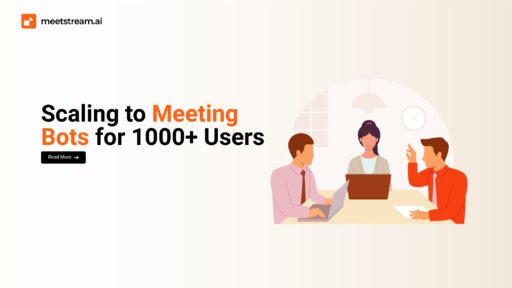

According to Zoom’s own data, the platform hosts over 3 billion meeting minutes per day. For enterprise software teams building meeting bots that need to operate at scale, this represents a massive concurrency challenge: bots must join and process thousands of simultaneous sessions without degradation in speed, accuracy, or reliability.
A meeting bot that works flawlessly for 10 concurrent users often hits unexpected limits at 100, and catastrophic failure at 1,000. The architecture decisions that seem adequate for early-stage deployments, a single server, simple polling, monolithic design, become the bottlenecks that prevent growth.
Scaling meeting bots for enterprise use means architecting a distributed, event-driven system capable of handling thousands of concurrent media streams, managing stateful session isolation, and auto-scaling processing capacity in response to demand, all while maintaining sub-second latency and strict data compliance.
In this guide, we will explore the architectural patterns, infrastructure strategies, and operational best practices for scaling meeting bots to support 1,000 or more concurrent users, drawing on cloud-native design principles and real-world performance optimization. Let’s get started!
What Does Scaling Mean for Meeting Bots?
Definition of scaling in the context of real-time collaboration. Scaling for meeting bots means the ability of the system to increase its capacity to handle a growing number of simultaneous users and meetings without degradation in service quality (e.g., latency, accuracy). It involves supporting a higher volume of real-time media, data streams, and API calls.
Differences between supporting 10 users vs. 1000+ users.
- 10 Users: Simple, single server/instance deployment. Failures affect few people. Concurrency is easily managed.
- 1000+ Users: Requires a distributed, multi-region architecture. Failures must be isolated and self-healing. Concurrency necessitates sophisticated resource scheduling and load balancing to manage hundreds of simultaneous, persistent connections.
Key dimensions: performance, concurrency, reliability, cost.
- Performance: Minimizing latency in joining meetings, processing media, and delivering data.
- Concurrency: Handling the simultaneous demand from thousands of users and meetings.
- Reliability: Ensuring high availability and fault tolerance across all services.
- Cost: Optimizing infrastructure usage to ensure the per-user cost remains acceptable as usage grows.
Architectural Considerations for Scaling
Scaling to the enterprise level is fundamentally an architectural challenge, not a configuration tweak.
Distributed system design for real-time workloads. The core requirement is to break the bot’s functionality into independent services, a microservices architecture. This allows components like the media ingestion service, transcription engine, and data persistence layer to be scaled independently based on their specific workload demands.
Cloud-native deployment (Docker, Kubernetes). Kubernetes (K8s) is the gold standard for enterprise-scale deployments. It manages containerized bot instances (Docker), providing automated deployment, scaling, and self-healing capabilities. This abstracts away the complexity of managing thousands of compute resources.
Horizontal vs. vertical scaling trade-offs.
- Vertical Scaling (Scaling Up): Adding more CPU/RAM to a single server. Quick, but hits a ceiling and creates a single point of failure.
- Horizontal Scaling (Scaling Out): Adding more identical, smaller bot instances. This is the preferred method for enterprise scale, offering superior redundancy and near-limitless capacity.
Load balancing across multiple bot instances. An intelligent load balancer is essential. It must distribute new meeting requests to the least-busy bot instance based on real-time resource metrics (CPU, memory, active meetings). Advanced load balancing can even factor in geographic location for lower latency.
Handling Concurrency in Large-Scale Bots
Concurrency is the moment-to-moment test of a scaling strategy.
Managing multiple concurrent meetings. Each meeting requires a dedicated, persistent connection and stream processing pipeline. Enterprise bots must use an event-driven architecture where a central scheduler efficiently manages the lifecycle of thousands of these meeting “sessions.”
Efficient use of APIs and event subscriptions. Rely on event-driven APIs (webhooks/subscriptions) rather than constant polling. This minimizes unnecessary requests, reduces the load on the platform API (Zoom, Teams, etc.), and allows the bot to react instantly to changes like a user joining or leaving.
Techniques for session isolation to prevent cross-talk. Each meeting session must be isolated within its own container or process to ensure data integrity. This prevents data from one meeting (e.g., transcripts, recordings) from mixing with another, a non-negotiable security requirement.
Importance of real-time monitoring for concurrency issues. Concurrency issues often manifest as subtle performance dips. Implementing real-time dashboards to track key metrics, such as average meeting latency, API error rates, and resource utilization per instance is crucial for proactive problem-solving.
Optimizing Media Pipelines for Scale
The media pipeline (audio and video) is the most resource-intensive component.
Scaling audio and video processing. The key is to leverage stateless media processing services. This means media can be routed through any available processing worker, which performs its task (e.g., noise reduction, speech-to-text conversion) and then passes the result along, enabling easy horizontal scaling.
Reducing latency while handling high volumes. Latency is minimized by placing processing nodes geographically close to the meeting participants (or the platform’s media relay servers). Use high-performance frameworks like WebRTC or specialized media servers rather than simple HTTP streaming.
Leveraging edge computing for performance boosts. For global deployments, edge computing can place lightweight processing tasks (e.g., initial media decoding) closer to the user, offloading the central data center and significantly reducing end-to-end latency.
Compression and bandwidth optimization techniques. Use efficient codecs (like Opus for audio) and dynamically adjust bitrates based on network conditions. Only ingest the minimum required media streams (e.g., only audio for transcription bots) to conserve bandwidth and processing power.
Data Management at Enterprise Scale
The output of thousands of meetings quickly generates petabytes of highly sensitive data.
Secure storage of transcripts and recordings. Use cloud storage services (S3, GCS) that provide high durability, encryption-at-rest, and granular access controls. Data should be encrypted both in transit and at rest.
Database scaling (SQL vs. NoSQL).
- SQL (PostgreSQL, MySQL): Excellent for transactional data (user profiles, billing) where complex relations and strong consistency are required. Can be scaled using read replicas and sharding.
- NoSQL (MongoDB, Cassandra): Ideal for storing meeting-related metadata, raw transcript chunks, and time-series data due to its superior horizontal scaling and high-throughput write capabilities.
Handling high-throughput data pipelines. Implement a message queue system (Kafka, RabbitMQ) between the media processing layer and the data persistence layer. This decouples the services, buffering bursts of data and ensuring no meeting data is lost during periods of high load or service failure.
Data retention and compliance considerations. Implement automated policies that classify data (e.g., based on sensitivity), apply appropriate retention periods, and securely delete data according to compliance mandates (e.g., “7 years of financial records”).
Security & Compliance for 1000+ Users
Security stops being an add-on and becomes a foundational component.
Role-based access control (RBAC) at scale. Implement a sophisticated RBAC system that dictates who (user, admin, auditor) can access what (transcript, recording, settings) and when (post-meeting, during meeting). This must integrate seamlessly with the enterprise’s existing identity provider (SSO).
Token management and short-lived credentials. Never use long-lived API keys. All credentials for accessing meeting platforms or internal services must be short-lived access tokens that automatically expire and are securely rotated, minimizing the window for compromise.
Meeting compliance standards (GDPR, HIPAA, SOC 2).
- GDPR (Europe): Requires data localization and explicit user consent for processing.
- HIPAA (Healthcare): Mandates specific security controls for handling Protected Health Information (PHI).
- SOC 2 (General Enterprise): Demonstrates internal controls over security, availability, processing integrity, confidentiality, and privacy.
Protecting against data leaks and unauthorized access. Use network segmentation (isolating different parts of the architecture) and robust Vulnerability Management processes to continuously scan for and patch security flaws.
Performance Optimization Strategies
Sustained performance requires meticulous tuning.
Caching frequently accessed data. Use an in-memory store like Redis to cache user settings, access tokens, and segments of frequently viewed transcripts, reducing the load on the database and speeding up response times.
Using CDNs for distributed delivery. Leverage a Content Delivery Network (CDN) to distribute static assets (e.g., web UI code, help documentation) and potentially post-meeting summary documents, speeding up delivery to global users.
API rate limit management. Implement a client-side throttling and queuing layer within the bot. If a meeting platform imposes a rate limit, the bot must queue subsequent requests and retry intelligently rather than failing outright.
Monitoring with observability tools (Prometheus, Grafana, ELK stack). A robust observability stack is non-negotiable:
- Prometheus: For collecting real-time metrics.
- Grafana: For visualizing performance dashboards.
- ELK Stack (Elasticsearch, Logstash, Kibana): For centralized logging and log analysis.
Common Challenges When Scaling Meeting Bots
Even with perfect architecture, real-world factors pose hurdles.
API throttling by meeting platforms. The single biggest challenge. Platforms (Zoom, Teams, Webex) impose strict rate limits. Solution: Negotiate higher enterprise limits, implement exponential back-off strategies, and prioritize mission-critical API calls.
Network latency across geographies. A bot in New York will have high latency joining a meeting in Tokyo. Solution:Deploy bot infrastructure in multiple cloud regions (multi-region deployment) and route meeting connections to the closest available instance.
Debugging failures in live large-scale deployments. Failures are often non-reproducible race conditions. Solution:Distributed tracing (using tools like Jaeger or Zipkin) to visualize the flow of a single meeting request across dozens of microservices.
Balancing cost vs. performance. High performance often means expensive, over-provisioned resources. Solution:Implement granular auto-scaling policies that match capacity precisely to demand, spinning down instances during low-activity hours.
Best Practices for Large-Scale Deployment
These practices ensure agility and stability.
Use CI/CD pipelines for frequent updates. Continuous Integration/Continuous Deployment (CI/CD) pipelines automate the testing and release process. This allows for frequent, small, low-risk deployments instead of massive, high-risk quarterly updates.
Implement auto-scaling policies. Configure Kubernetes and cloud providers to automatically adjust the number of bot instances based on metrics like CPU usage, queue length, or the number of active meetings.
Stress test bots under simulated workloads. Before a new feature rollout, use load-testing tools (like JMeter or K6) to simulate 1000 concurrent meetings, identifying bottlenecks and failure points before they impact live users.
Adopt modular microservices for easier scaling. Ensure that each microservice performs a single function. This makes it easier to isolate failures, upgrade components independently, and scale only the services that are under load.
Future of Large-Scale Meeting Bots
The horizon for enterprise bot scaling is exciting.
AI-driven scaling (predictive auto-scaling). Using machine learning models to analyze historical usage patterns and predict upcoming spikes (e.g., “Monday morning peak”) to pre-scale resources before the load hits, eliminating cold start latency.
Serverless architectures for cost efficiency. Moving processing to serverless functions (AWS Lambda, Azure Functions) for highly volatile, intermittent tasks (like post-meeting summary generation), paying only for the compute time used.
Deeper integrations with enterprise ecosystems. As bots scale, they will require seamless, low-latency integrations with internal enterprise tools (CRMs, HR systems, data warehouses) that can handle massive data exchange volumes.
How 5G and edge computing will reshape scaling strategies. The combination of low-latency 5G networks and closer edge data centers will enable even more processing to be pushed away from the core, potentially allowing for real-time transcription and analysis to occur so quickly that the results are available before the speaker finishes their sentence.
Conclusion
Recap of why scaling is essential for enterprise meeting bots. Scaling is not a luxury; it is the defining feature that separates a successful enterprise bot from a failed proof-of-concept. It ensures reliability, security, and performance across global operations.
Key architectural and best practice takeaways. The road to 1000+ users is paved with microservices, guarded by Kubernetes, optimized by caching and CDNs, and secured by short-lived tokens and strict compliance.
How do you scale meeting bots for thousands of users?
Scaling meeting bots for thousands of users requires a microservices architecture deployed on Kubernetes with horizontal auto-scaling, event-driven processing using message queues like Kafka, multi-region deployment to minimize latency, and stateless media processing workers that can be scaled independently. Load balancers distribute meeting connections across available bot instances based on real-time resource metrics.
What infrastructure do enterprise meeting bots need?
Enterprise meeting bots require a media ingestion layer for capturing audio and video streams, distributed transcription and NLP processing services, a message queue for decoupling high-throughput data flows, encrypted cloud storage for transcripts and recordings, a load balancer for distributing concurrent meetings, and an observability stack (Prometheus, Grafana, ELK) for monitoring performance and errors.
How do you handle concurrent bot sessions?
Concurrent bot sessions are managed by isolating each meeting in its own container or process to prevent data cross-contamination, using an event-driven scheduler to manage session lifecycles, and relying on webhook-based APIs rather than polling to minimize unnecessary load. Kubernetes handles the orchestration of hundreds of isolated session containers automatically.
What are the bottlenecks when scaling meeting bots?
The most common bottlenecks when scaling meeting bots are API rate limits imposed by platforms like Zoom or Teams, media processing throughput (audio decoding and STT are CPU and memory intensive), database write performance under high concurrent load, and network latency for geographically distributed participants. Addressing these requires exponential backoff strategies, stateless processing workers, NoSQL databases for high-throughput writes, and multi-region deployment.