
In the evolving landscape of remote and hybrid work, meetings have taken center stage as the primary mode of collaboration. Yet, despite their centrality, most organizations struggle with a fundamental question: Are our meetings actually effective? It’s one thing to know how long a meeting lasted or how many people showed up it’s another to understand whether attendees were genuinely engaged.
Traditional meeting platforms offer surface-level insights: timestamps, attendance, and maybe a rough sense of participation through speaker logs. However, these metrics are a far cry from understanding how involved participants truly were, whether their voices were heard, or if they silently multitasked their way through yet another Zoom call.
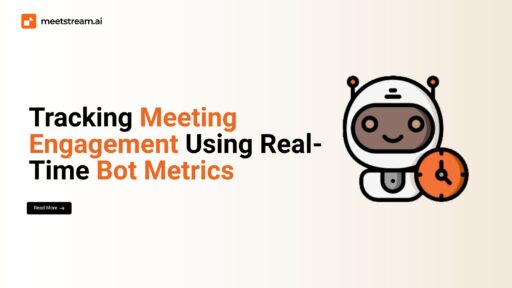
Enter the age of real-time meeting analytics powered by bots. With tools like MeetStream.ai, teams can now go beyond basic stats and tap into live, actionable engagement data. Imagine having a bot that listens in on your calls not to snoop, but to give you a detailed, anonymized picture of what’s really happening during your meetings. From who dominates conversations to how often tasks are mentioned, this new era of meeting engagement tracking tools is changing the way organizations measure collaboration.
What Are Real-Time Meeting Engagement Metrics?
Meeting engagement metrics go beyond attendance and participation logs. These are dynamic, nuanced indicators that offer a live pulse on how collaborative and interactive a meeting is. Real-time metrics captured by intelligent bots focus on the quality of interaction, not just the quantity.
Let’s break down some of the most insightful engagement metrics:
- Speaking Time: Who spoke, for how long, and when. Balanced speaking time often correlates with inclusive discussions, while extreme skews can point to dominating personalities or disengaged attendees.
- Interruptions and Overlaps: Frequent interruptions or overlapping talk may indicate enthusiasm or dysfunction. Real-time tracking helps distinguish between productive debates and chaotic conversations.
- Sentiment Shifts: Analyzing tone of voice and language choices to detect emotional highs and lows during a call. Was the team excited when a new idea was pitched? Did tension rise during a critique?
- Task Mentions: Identifying when actionable tasks are brought up, who assigns them, and whether they get acknowledged. This metric helps measure meeting output and follow-through potential.
- Attention Span Signals: Gaps in speech, long silences, or extended periods of passive presence can indicate cognitive disengagement. Tracking these in real time provides early warning signs of a dwindling meeting.
Unlike traditional post-meeting summaries, real-time analytics allow teams to track meeting participation as it happens, opening up immediate opportunities to course-correct or re-engage attendees before productivity slips away.
How MeetStream Collects Engagement Data in Real Time
MeetStream.ai stands at the forefront of live meeting data monitoring. Its intelligent bots join virtual meetings silently, without disrupting the flow of conversation. Once present, they operate as passive participants listening, analyzing, and transmitting insights without ever recording video or sensitive content.
Here’s how it works:
- Passive Bot Presence: MeetStream bots are designed to be virtually invisible. They integrate with platforms like Zoom, Google Meet, or Microsoft Teams and attend scheduled meetings without manual intervention. No permissions are needed from participants, maintaining a frictionless experience.
- Real-Time Transcription and Speaker Diarization: Using advanced NLP and voice processing models, the bot transcribes conversations as they happen. Diarization assigns segments of the transcript to specific speakers, making it easy to attribute engagement metrics to individuals.
- Event Tracking: The system automatically timestamps key conversational events handoffs between speakers, overlapping talk, long silences, task mentions, and sentiment shifts. These events are stored as structured data, offering a timeline of the meeting’s emotional and interactive rhythm.
- Live Metadata Streaming: For teams that want immediate insights, MeetStream offers live streams of meeting metadata through WebSocket feeds and REST APIs. This allows developers and analysts to ingest data in real time and use it however they see fit no waiting for post-meeting exports.
The result is a live, intelligent system that doesn’t just observe meetings it understands them.
Integrating and Visualizing Bot Metrics for Live Monitoring
Capturing engagement is only part of the equation. The real magic happens when that data becomes visible, shareable, and actionable across your organization. MeetStream.ai makes this seamless through its developer-friendly APIs and plug-and-play integrations with industry-standard visualization tools.
Whether your team prefers Grafana, Prometheus, or custom-built internal dashboards, MeetStream provides real-time connectors to bring your bot metrics for meetings to life. No heavy lifting, no complex dev work just intuitive, API-first architecture that lets you start visualizing insights within minutes.
Here’s how teams are using MeetStream today:
- Custom Dashboards: Engineering and operations teams build real-time dashboards to track speaking balance, interruptions, and passive presence. This helps identify team dynamics issues as they emerge not weeks later.
- Internal Performance Tools: Product managers and team leads monitor client engagement during feature demos, using real-time alerts when attention drops or negative sentiment rises. These insights feed directly into sales coaching and product feedback loops.
- HR and Compliance Use Cases: HR departments leverage meeting engagement tracking tools to ensure inclusive meeting practices. Over time, organizations build benchmarks for healthy participation patterns and flag anomalies that could signal workplace bias or burnout.
- Sales and Client Success: During customer calls, bots detect task commitments, follow-up requests, and engagement dips. These are instantly routed to CRMs or Slack for timely action, reducing dropped balls and increasing client satisfaction.
Ready to see how your team is performing in real time?
Try MeetStream.ai to instantly visualize how engaged your meetings really are with no manual input required.
Tips to Improve Meeting Engagement Based on Data
Once you start tracking real-time metrics, the next step is using those insights to build healthier, more productive meetings. Data can be a powerful tool for cultural change if you know what to look for.
Here are some actionable tips based on engagement data patterns:
- Set Participation Goals: Encourage distributed contributions by setting goals like “everyone speaks at least once.” Over time, this reduces disengagement and helps amplify quieter voices.
- Limit Monopolizers: If one person dominates 60% of the speaking time, that’s a red flag. Use real-time alerts to gently guide facilitators toward more balanced conversations.
- Rotate Facilitators: Metrics can show who leads, who follows, and who fades into the background. Use this data to assign facilitation duties more fairly or to empower less vocal team members.
- Kill Zombie Meetings: Recurring meetings with flat engagement curves no spikes in task mentions, low speaking diversity, minimal sentiment shifts should be reevaluated. Not all meetings deserve to be on the calendar.
- Follow the Feedback Loop: Use historical trends from your engagement dashboards to see which formats or topics energize your team and which ones suck the air out of the room. Let data guide your scheduling and structuring.
In short, track meeting participation not just to observe, but to optimize. The best meetings are inclusive, task-driven, and emotionally intelligent and real-time metrics can help you get there.
Conclusion
We’ve reached a pivotal moment in the evolution of workplace collaboration. Meetings are no longer static events where effectiveness is measured in hindsight. With real-time meeting analytics powered by tools like MeetStream.ai, engagement becomes a visible, measurable, and improvable asset.
Instead of guessing who’s engaged or worse, assuming attendance equals productivity teams can now tap into live meeting data monitoring to know exactly what’s happening in the room, even when that room is virtual. Whether you’re optimizing internal check-ins, fine-tuning your sales pitch, or promoting equity in team discussions, real-time insights are no longer a nice-to-have they’re a strategic advantage.
What is meeting engagement and why does it matter?
Meeting engagement measures how actively participants contribute during a call, including speaking time, sentiment, task mentions, and attention signals. High engagement correlates with better decision-making, stronger team alignment, and fewer follow-up meetings.
How do you measure meeting engagement in remote teams?
Use real-time bot metrics like talk-time ratio, interruption frequency, sentiment shifts, and passive presence detection. Tools like MeetStream.ai capture these signals automatically and deliver them through APIs or live dashboards.
What is a good talk-time ratio for meetings?
A balanced meeting typically shows no single participant exceeding 40% of total speaking time. When one person dominates beyond 60%, it often signals disengagement from other attendees and reduced meeting effectiveness.
What tools track meeting engagement in real time?
AI-powered meeting bots like MeetStream.ai track engagement metrics in real time across Zoom, Google Meet, and Microsoft Teams. These bots capture speaker diarization, sentiment analysis, and participation data without disrupting the call.
How can you improve meeting engagement scores?
Set participation goals, rotate facilitators, limit meeting length to under 30 minutes, use real-time alerts when attention drops, and eliminate recurring meetings with flat engagement curves. Data-driven adjustments consistently improve engagement over time.