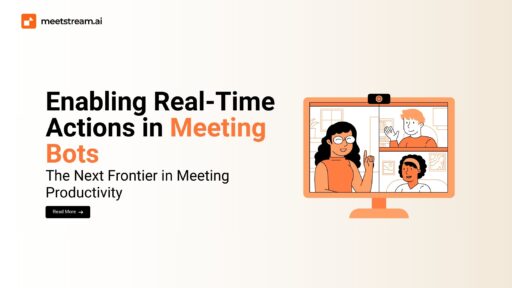

Why real-time responsiveness is the next frontier for meeting bots. In the fast-paced world of remote and hybrid work, the speed of action often determines the success of a project or deal. While meeting bots have become indispensable, the next major leap in productivity isn’t just about documenting what was said—it’s about acting on it immediately. Real-time responsiveness is transforming meeting assistants from passive listeners into active collaborators.
Difference between passive bots (note-taking) vs. active bots that trigger actions instantly. Traditionally, meeting bots were passive. They transcribed, summarized, and maybe highlighted key moments, but the burden of taking the next step(like creating a task or updating a CRM) still fell to a human after the meeting ended. Active bots, conversely, are designed to detect intent and trigger actions in the moment, bridging the gap between conversation and execution.
What this guide will cover for developers and businesses. This guide will explore the architecture, use cases, and technical considerations for developers and businesses looking to integrate real-time action capabilities into their meeting bots. We’ll cover the core technologies required, common workflows, and crucial security best practices for making your meeting bot an instantaneous productivity engine.
What Are Real-Time Actions in Meeting Bots?
Definition of real-time actions in the context of meetings. Real-time actions are automated workflows executed instantaneously based on contextual triggers (keywords, intents, or sentiment) detected during a live meeting. The goal is to eliminate post-meeting friction and ensure decisions translate into action without delay.
Examples: sending reminders, updating CRMs, triggering workflows mid-meeting. Imagine a sales call where a prospect mentions a specific integration need. A real-time action could instantly update the CRM with the required integration details. During a project meeting, if the phrase “I’ll take the lead on that” is spoken, the bot can immediately auto-create a task in Jira assigned to that person. Other examples include sending a technical doc via chat when a specific product feature is discussed or alerting a manager if a critical keyword like “escalation” is mentioned.
How they improve productivity and decision-making. By executing actions instantly, real-time bots dramatically reduce the administrative overhead that typically consumes the first hour post-meeting. This speeds up project timelines, improves data integrity (since data is logged while the context is fresh), and accelerates decision-making by providing instantaneous data access or initiating necessary processes.
Core Technologies Behind Real-Time Actions
Enabling instantaneous actions requires a sophisticated blend of low-latency communication and advanced AI processing.
Webhooks and event subscriptions. These are foundational for real-time integration. Webhooks allow the meeting bot’s system to send an automated HTTP POST request (an “event”) to a third-party application (e.g., Slack or Jira) immediately after a trigger condition is met, enabling a near-instantaneous response.
Real-time APIs and socket connections. For communication with the meeting platform itself (like Zoom or Google Meet), real-time APIs or WebSocket connections are essential. These ensure that the bot is processing the audio/video stream with minimal latency, allowing it to detect an event mere seconds after it occurs.
Speech-to-Text (STT) + NLP for intent detection. The most critical component is the fusion of high-accuracy Speech-to-Text (STT) to convert spoken words into text, followed by advanced Natural Language Processing (NLP) and Natural Language Understanding (NLU) models. These models are trained to move beyond simple keyword spotting to accurately detect the intent behind the words (e.g., distinguishing “I need to look into next steps” as a task assignment intent).
Integration with third-party tools (Slack, Jira, Notion, Salesforce). The value of a real-time action is directly proportional to its connectivity. Deep, reliable integration with common enterprise tools, from communication platforms (Slack, Teams) to project management (Jira, Asana) and CRMs (Salesforce) is non-negotiable for executing meaningful automated actions.
Common Use Cases of Real-Time Actions
These use cases illustrate how immediate execution transforms meeting output.
Auto-creating tasks during project meetings. When a team member verbally commits to a deliverable, the bot detects the commitment intent and immediately creates a task in the project management tool, tagging the owner and noting the context.
Sending follow-up emails after client calls. If the conversation concludes with an agreed-upon next step, like sending a proposal or a case study, the bot can draft and stage the follow-up email, ensuring it’s ready to send the moment the meeting ends, or even auto-sending a pre-approved template mid-call.
Alerting managers if critical keywords (e.g., “contract,” “escalation”) are mentioned. In regulated industries or high-stakes scenarios, real-time alerts are vital. If “compliance issue,” “contract terms,” or “escalation” are detected, the bot can instantly notify a supervisor or legal team via a private channel, ensuring immediate awareness and intervention if necessary.
Triggering knowledge base lookups during training sessions. During product training or support calls, if a specific technical term or product ID is mentioned, the bot can trigger a knowledge base search and post a link to the relevant documentation directly into the meeting chat for immediate reference.
Designing a Real-Time Action Workflow
Developing an effective real-time action capability follows a four-step cycle:
Step 1: Capture live meeting data (audio, video, chat). The system must establish a low-latency connection to the meeting source to capture raw data streams. This step’s efficiency is paramount to minimizing overall latency.
Step 2: Process via NLP/AI to detect intents. The audio is transcribed via STT, and the resulting text is fed into the NLU model. The model analyzes the language, context, and speaker to accurately classify the intent, keyword, or sentiment.
Step 3: Map detected intents to actions. The classified intent is matched against a predefined rule set (e.g., “Intent: Task Assignment” maps to “Action: Create Jira Ticket”). This mapping defines which integration to call and what data to pass.
Step 4: Execute action through integrations. The system calls the appropriate third-party API or sends a webhook, securely transferring the necessary data (e.g., task description, assignee, due date) to execute the workflow.
Example workflow: “Assign task to Jira when ‘next steps’ is mentioned.”
- Capture: Speaker says: “Okay, as next steps, I’ll draft the proposal and get it to Sarah by Friday.”
- Process: NLU model detects the trigger phrase “next steps” and classifies the surrounding context as the Task Assignment intent, identifying the task (draft the proposal), assignee (I’ll/Speaker A), and due date (Friday).
- Map: Task Assignment intent is mapped to the Jira Task Creation action.
- Execute: The bot sends an API call to Jira, creating a new ticket titled “Draft Proposal,” assigned to Speaker A, with a due date of Friday.
Challenges in Enabling Real-Time Actions
While powerful, building and maintaining real-time action capability introduces several technical hurdles.
Handling latency and ensuring immediate response. Every millisecond matters. The entire chain, from audio capture to STT, NLP processing, API call, and external tool response must be engineered for low latency to truly feel “real-time” to the user.
Avoiding false triggers from inaccurate transcription. A critical challenge is the risk of false positives. If the STT mishears a word or the NLP misinterprets the context, an automated action could be triggered erroneously (e.g., accidentally creating a sensitive task). This requires high-confidence thresholds.
Managing API rate limits for integrations. Executing dozens of real-time actions across various third-party tools can quickly hit API rate limits, especially in busy organizations. Developers must implement robust queuing, throttling, and exponential backoff strategies to manage external dependencies gracefully.
Ensuring security and compliance when automating actions. Automating actions means the bot is now interacting with sensitive enterprise data systems. Developers must ensure all API calls are authenticated, secure, and adhere to compliance standards.
Best Practices for Developers
To build a reliable and valuable real-time action system, developers should adhere to these practices:
Use confidence thresholds in NLP to reduce false positives. Instead of triggering an action on any perceived intent, set a high-confidence score requirement (e.g., 95%). If the confidence is lower, the bot can ask for confirmation in the chat (“Did you mean to create a task?”) or log the event for human review instead of executing the action.
Allow user confirmation before executing high-impact actions. For actions that have significant business consequences (e.g., deleting a record, sending a final invoice), the system should pause and prompt the user in the meeting chat for explicit confirmation before proceeding.
Implement retry and fallback mechanisms. API calls can fail due to network issues, rate limits, or external server errors. Implement logic to automatically retry failed API calls with a delay and have a fallback mechanism (e.g., logging the failure and notifying the user) to prevent data loss.
Monitor performance with logging and analytics. Extensive logging is crucial. Track the time taken for each step (latency), the accuracy of intent detection (true positives vs. false positives), and the success rate of integration calls. Use this data to continuously refine STT and NLU models.
Real-Time Actions and Security Considerations
As meeting bots take on more operational roles, security moves from a feature to a necessity.
Validating events before executing actions. Ensure that the user who uttered the trigger is authorized to perform the resulting action in the target system (e.g., a guest in the meeting should not be able to assign a task in a private Jira board).
Role-based access to prevent unauthorized triggers. Implement strict role-based access control (RBAC). Only authenticated users or specific roles (e.g., ‘Meeting Host’ or ‘Project Manager’) should have permissions to initiate specific high-level actions.
Protecting sensitive data when sharing with third-party apps. Actions often involve transferring sensitive data (e.g., client names, contract values). Ensure data transfer uses secure, encrypted protocols (TLS/SSL) and that third-party integrations adhere to data retention and processing policies.
Compliance considerations (GDPR, HIPAA, SOC 2). For organizations in regulated fields, ensure that real-time actions and the underlying infrastructure comply with relevant standards like GDPR (data protection), HIPAA (healthcare data), and SOC 2 (security controls). This often requires audit trails for every automated action.
Future of Real-Time Actions in Meeting Bots
The foundation is set, but the future promises even deeper integration and intelligence.
AI agents that proactively suggest next steps. The next generation of bots won’t just react to spoken intents; they will predict and suggest. For example, an AI agent might recognize a stalled decision and proactively suggest the next logical step based on historical project data.
Multimodal inputs (voice, chat, video recognition). Future bots will combine voice data with non-verbal cues. If a user says “yes” while simultaneously nodding and smiling (detected via video recognition), the confidence threshold for a positive action could be instantly boosted. Chat inputs will also be integrated seamlessly into the action workflow.
Deeper workflow automation across enterprise ecosystems. Expect meeting bots to become the central orchestration layer for complex, multi-step workflows that span across five or six different enterprise applications simultaneously, making the entire business process event-driven and instantaneous.
Potential role in fully autonomous meeting assistants. Eventually, real-time actions are a step toward fully autonomous assistants that can manage large portions of a meeting, handle task assignments, follow-ups, and even resource allocation without continuous human intervention.
Conclusion
Recap of why real-time actions make meeting bots more valuable. Real-time actions shift the meeting bot paradigm from a useful note-taker to an essential operational partner. By instantly translating conversation into execution, they eliminate post-meeting administrative burden, improve data quality, and accelerate business outcomes.
Key practices for enabling secure, reliable, and productive actions. Success in this frontier depends on low-latency engineering, high-confidence NLP, robust integration management (retry/fallback), and non-negotiable security protocols like RBAC and full compliance.
Final thought: the future of meetings is not just documenting, but acting in the moment. For businesses and developers at the forefront, the message is clear: the most productive meeting is one where the action begins before the call ends. Embrace real-time res